
Following its departure from Oostende in Belgium on August 30, the world’s largest solar boat, PlanetSolar, arrived in London a day later, bringing its campaign of scientific measurements along the Gulf Stream, known as the “DeepWater” scientific expedition, to an end.
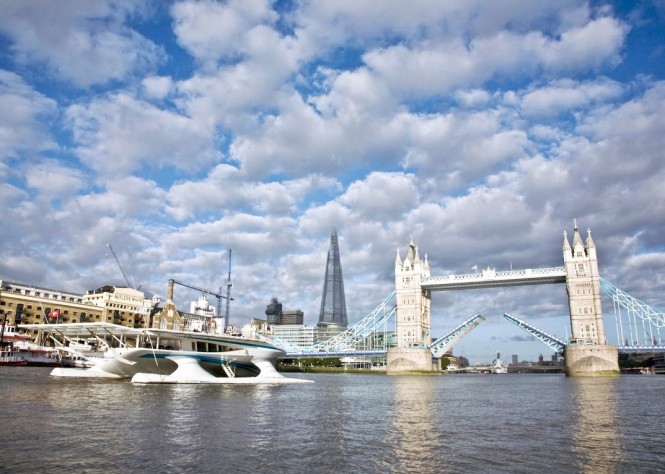
PlanetSolar - Tower Bridge, London - Photo by Ania Dabrowska
The catamaran had been transformed into a scientific platform since the month of June; the onboard team of researchers from the University of Geneva (UNIGE) completed its collection of unprecedented data between Oostende and London. The information gathered will be analyzed at UNIGE. The ship sailed on the Thames for the first time, near the Tower Bridge, and finally moored at the West India Docks in the heart of the British city.
After tracking the Gulf Stream for over 8,000 km, the “PlanetSolar DeepWater” scientific expedition, carried out in collaboration with the University of Geneva (UNIGE), ended in the British capital on Saturday, August 31. The London stopover successfully concluded this unique measurement campaign, which led the ship and her crew, composed of both sailors and researchers, along the trail of the Gulf Stream, the primary regulator of European and North American climate.
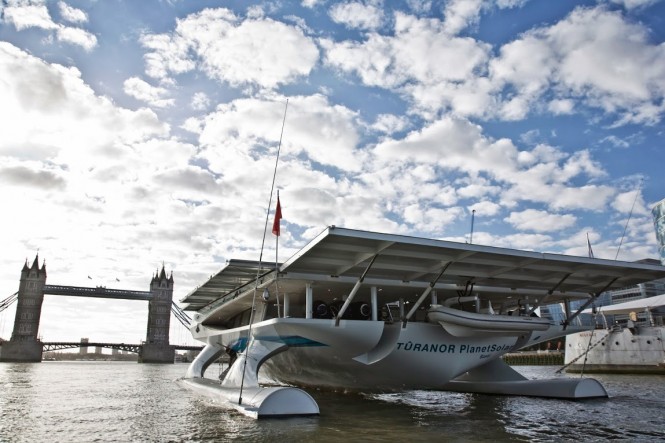
PlanetSolar in London - Photo by Ania Dabrowska
UNIGE is excited about analyzing the data, and is drawing a positive initial assessment of the expedition. “PlanetSolar DeepWater made it possible to test several scientific instruments—some of which were prototypes developed at UNIGE—in real conditions. Extensive physical, chemical, and biological data is now in the hands of UNIGE and will be the subject of a thorough analysis. Although the study of this information is not yet under way, interesting trends are becoming apparent, particularly in relation to sea spray aerosol production,” states Martin Beniston, climatologist and director of the Institute of Environmental Sciences at UNIGE.
During this scientific journey, the MS Tûranor PlanetSolar made a number of stopovers—in Miami, New York, Boston (United States), Halifax, St. John’s (Canada), and Oostende (Belgium). These steps were unique opportunities to communicate the stakes of the “DeepWater” expedition, and raise public awareness about the issue of climate change. These communicative actions will continue until the Paris stopover, which will mark the endpoint of the 2013 PlanetSolar campaign.

