
The Oceana Organisation was founded in 2001 and it is the largest international organization which is focused solely on ocean conservation, protecting marine ecosystems and endangered species.
Oceana has offices in Europe, North America, Central America and South America which work together on a limited number of strategic, directed campaigns to achieve measurable outcomes that will help return our oceans to former levels of abundance. The Oceana Ocean Organisation believes in the importance of science in identifying problems and solutions and scientists work closely with our teams of economists, lawyers and advocates to achieve tangible results for the oceans.
Oceana, a Planet Green NGO partner, is an organization that is at the forefront of ocean and ocean-life conservation. They have set forth campaigns to stop dirty fishing, destructive trawling, to protect sharks, sea turtles and people from mercury-contaminated seafood. They also work towards ending subsidized fishing and have advocated for reduced greenhouse emissions.
Oceans cover the majority of the earth’s surface, but we rarely ever visit them. They are the ultimate fly-over country. Oceans, however, contain an abundance of life, including phytoplankton which generate most of the oxygen that we breathe. So, you see, we kind of need oceans.
Oceana has over 300,000 members from all over the world, and you can become a member by signing up to be a Wavemaker. But you don’t have to join to support the ocean. You can donate or you can use their pocket seafood guide to distinguish what fish are endangered and what fish are OK to eat. Plus, they have a list of wonderful tips that can teach you how to live in sync with your planet’s oceans.
The Problem
The oceans are vast, but they are not immune to human influence. We have already altered or destroyed many marine ecosystems and driven million-year-old species to the brink of extinction. According to a study published in Science, less than 4 percent of the oceans remain unaffected by human activity.
We are taking too many fish out of the water.
In the last few decades, commercial fishing has evolved into a high-tech, heavily subsidized industry that uses cutting-edge electronics, computer systems, huge amounts of fuel and miles of gear to find and catch more fish in remote places formerly out of bounds to fishermen.
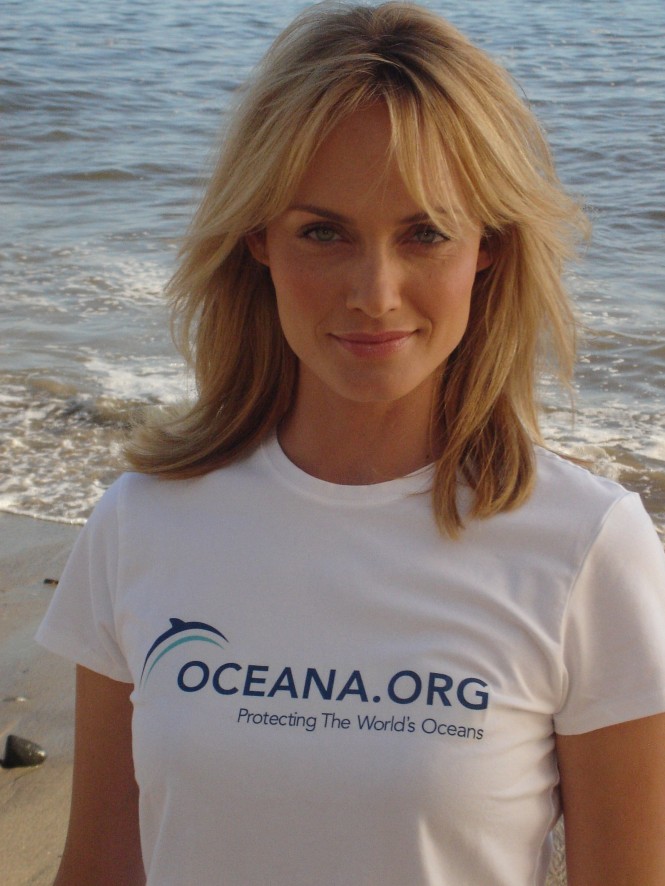
Amber Valletta
The U.N. Food and Agriculture Organization (FAO) says that at least 75 percent of seafood species are overexploited, fully exploited or recovering from depletion and need more effective and precautionary management.
We are putting too many pollutants in the water.
Mercury is a toxic pollutant emitted by land-based industrial plants. This mercury finds its way back into our food chain via our seafood with potentially serious consequences. According to the U.S. Environmental Protection Agency (EPA), one in ten American women has enough mercury in her blood to pose a risk of neurological damage to her developing baby.
Meanwhile, offshore fish farming, rather than taking the pressure off wild seafood species, results in increased overfishing to feed the farmed fish as well as the despoiling of seafloor habitat. Concentrated fish waste dropped from the open-water pens blankets the ocean bottom, snuffing out oxygen and life.
Last and perhaps most alarming, carbon dioxide is making our oceans warmer and more acidic . As a result, corals and other creatures at the base of the ocean food chains have trouble forming shells. Without a drastic reduction in carbon dioxide emissions, many of the world’s coral reefs will disappear and entire ocean ecosystems may collapse.
We are squandering the oceans’ resources.
Destructive fishing practices that include driftnets, longlines and bottom trawls are ruining ocean ecosystems by indiscriminately killing fish and other wildlife, including seabirds and marine mammals. Each year, more than 16 billion pounds of bycatch are thrown overboard thanks to wasteful fishing techniques.
Bottom trawls drag heavily weighted nets along the ocean floor in search of fish or crustaceans in a practice akin to clearcutting a forest in order to catch a rabbit. Centuries-old habitats such as coral gardens are destroyed in an instant by bottom trawls, pulverized into barren plains. Endangered sea turtles drown on longline hooks while sharks have their fins sliced from their bodies, which are then tossed overboard.
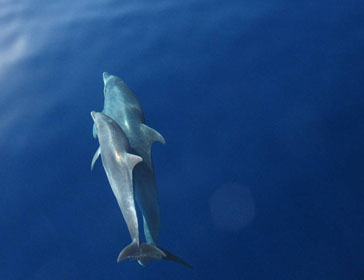
© OCEANA and Soledad Esnaola
The Oceana Goal
Oceana was created to identify practical solutions and make them happen. The good news is that we can restore our oceans to their former glory. In many cases, laws governing fishing and pollution already exist – we simply need to enforce them and ensure that management and industry obey a few commonsense principles.
To most effectively protect the world’s oceans, Oceana is:
MARINE-FOCUSED: Oceana is 100 percent dedicated to fighting on behalf of oceans.
GLOBAL: Oceana has campaign offices in North America, South America, Central America and Europe.
CAMPAIGN-DRIVEN: Oceana channels their resources towards a limited number of strategic, directed campaigns to achieve measurable outcomes that will help return our oceans to former levels of abundance. Some of our campaigns are regional, others are international.
FACT-BASED: Oceana believe in the importance of science in identifying problems and solutions.
Please visit oceana.org for more information

